

Yes. You can retake any A level, in any subject, as many times as you need to. There is no age limit, no cap on the number of attempts, and no rule that says you have to go back to the school or college where you sat the exams the first time. If you finished Year 13 with grades that closed a door you wanted open, that door is not closed permanently.
What follows is the practical detail, because “yes” is only useful if you know what the year looks like.
Who retakes, and why
Retake students arrive for all sorts of reasons. Some missed an offer by one grade in one subject. Some were ill during the exam period. Some were in the wrong subjects entirely and have realised, a year late, what they actually want to study. Some sat their exams in a school where they were one of thirty in a room and were never going to be spotted struggling in time.
None of those are unusual and none of them say anything durable about how able you are. In a typical year the students we teach on retake courses arrive with grades ranging from a clean set of Cs to a mixed set with one grade that has quietly wrecked an offer.
Retaking one subject, or all of them
You do not have to retake everything. Most students retake one or two subjects and leave the rest alone. If you have an A in Biology and a C in Chemistry and you need AAB for Medicine, the sensible course is a full year on Chemistry, some work on the third subject, and a completely untouched Biology grade that still counts.
Retaking a single subject is also considerably cheaper and considerably less exhausting than starting again from scratch, which matters when you are doing this alongside a job or a gap year plan.
Staying on the same exam board
This is the detail most people miss. If you retake with a different exam board from the one you sat originally, you are effectively learning a new specification: different set texts, different practical requirements, different assessment structure. That is a lot of avoidable work.
Wherever it is possible, a retake course should continue on the board and specification you already sat, so that everything you learned in two years still counts and the year is spent on the parts that did not land. All UK boards are available to a college that enters candidates itself, so ask about this early. If a provider cannot tell you which board they will enter you for, that is a real answer about how individually the course has been designed.
What a retake year actually involves
A good retake year is not a repeat of Year 13. It is a diagnosis followed by targeted work.
The diagnosis comes first: which topics were weak, which were fine, and whether the marks were lost on knowledge or on exam technique. Those two problems look identical on a results slip and need completely different remedies. A student who knows the content but writes disorganised twelve mark answers does not need to relearn the syllabus. They need to be taught how the mark scheme is applied and then made to practise it until it is automatic.
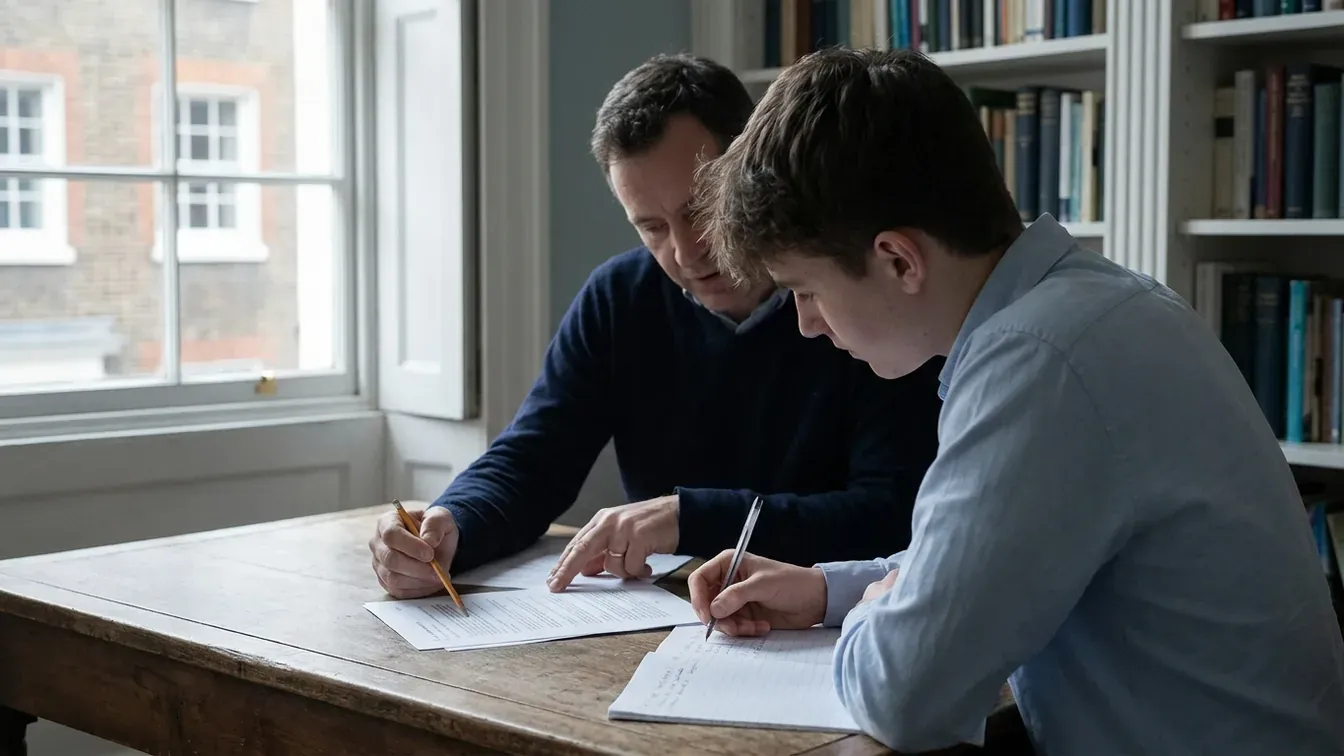
At Westminster Tutors that work happens one to one, or in a group of two or three. There is nowhere to hide in a lesson with one other student in it, which is uncomfortable for about a fortnight and then becomes the reason the year works. Every student also has an hour of individual mentoring each week, which is where the university plan, the timetable and the wobbles get dealt with rather than being left to build up.
Students on our A level retake courses improve by 1.5 grades on average.
Timing and entry
Most retake students start in September and sit exams the following summer. That is a full year and it is the version we would usually recommend, because it leaves room for mock exams, redrafting and a properly prepared UCAS application.
Shorter courses exist for students who only need one module or one subject, and for students who join in the autumn after a change of plan. If you are reading this in late August, do not assume it is too late; it usually is not.
Westminster Tutors is non selective, so there is no admissions test and no minimum grade profile. What matters at the interview is whether the course we would design for you is likely to get you where you want to go.
The question underneath the question
Most people asking whether they can retake are really asking whether it will count against them. That deserves a straight answer, and it has its own piece: do universities accept A level retakes? The short version is that the great majority treat a retake grade as a grade, and 94% of our retake students went on to a Russell Group university in 2026.
If you want to talk through your own results and what a year would look like, call the college or send an enquiry. It is usually a fifteen minute conversation and it is free.